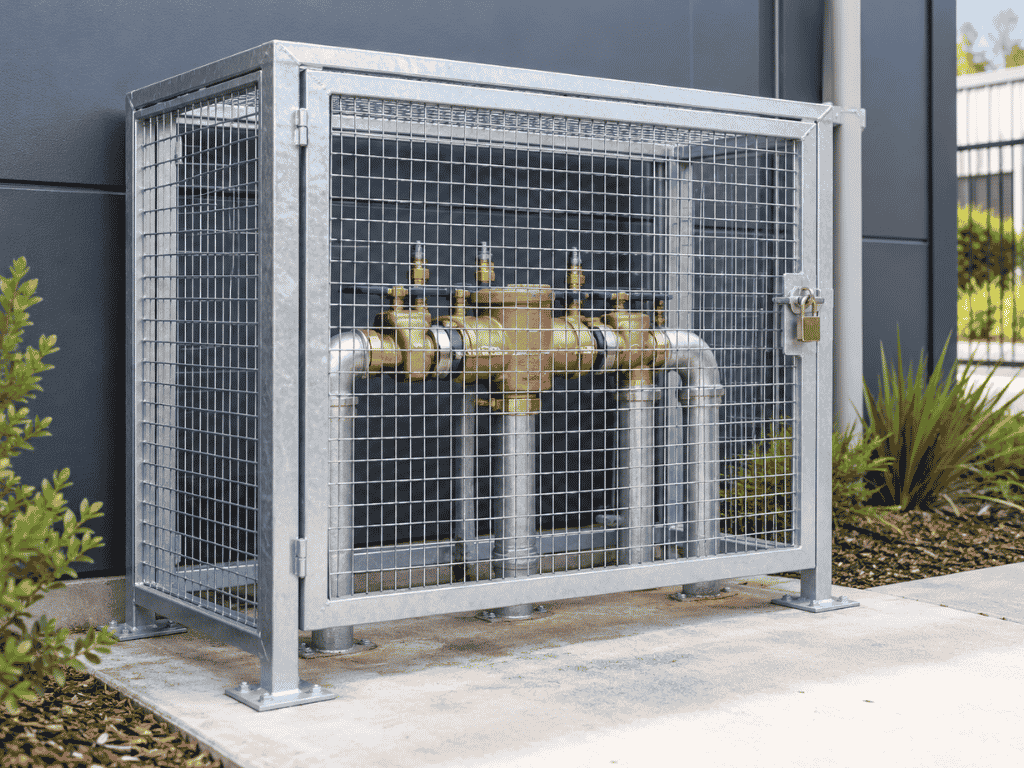
Reduced pressure zone valves play an important role in protecting drinking water supplies from contamination. However, because these valves are often installed above ground and in accessible areas, the equipment itself can be vulnerable to accidental damage, vandalism and unauthorised interference.
An RPZ cage provides a practical physical barrier around the valve assembly while still allowing authorised plumbers and technicians to access it when inspection, testing or maintenance is required.
For schools, commercial properties, council facilities and other sites where plumbing infrastructure is exposed, protecting an RPZ valve can be an important part of maintaining the site.
But what exactly is an RPZ cage, what does it protect, and when should you consider installing one?
This guide explains how RPZ cages work, where they are commonly used and what to look for when choosing an enclosure.
RPZ stands for Reduced Pressure Zone.
A Reduced Pressure Zone Device, often shortened to RPZD or RPZ valve, is a type of testable backflow prevention device.
Backflow occurs when water moves in the opposite direction to its intended flow. If this happens within a plumbing system, potentially contaminated water may be able to enter the drinking water supply.
An RPZ device is designed to reduce this risk.
The device contains two independently operating non-return valves together with a relief valve between them. Under appropriate operating conditions, this arrangement helps prevent water flowing backwards into the potable water supply. RPZ devices are commonly used as testable backflow prevention devices in higher-hazard applications where appropriate under relevant plumbing requirements.
Because backflow requirements vary according to the property, installation and hazard level, the correct device should always be determined by a suitably qualified plumbing professional.
An RPZ cage is a protective metal enclosure installed around a Reduced Pressure Zone valve or associated backflow prevention assembly.
Its purpose is straightforward: to reduce unauthorised access and protect exposed plumbing infrastructure from interference and physical damage.
An RPZ cage may also be referred to as a:
The terminology varies, but the basic purpose is the same.
Caged Up designs RPZ cages specifically for protecting Reduced Pressure Zone valves in locations where the equipment may otherwise remain exposed. Its cages are used in applications including schools, government and council projects, commercial developments and other high-traffic environments.
Importantly, an RPZ cage protects the valve. It does not replace the RPZ device itself, nor does it remove the requirement for correct plumbing installation, testing or maintenance.
RPZ devices are commonly installed in accessible above-ground locations so they can be inspected, tested and maintained as required.
Backflow prevention devices need to remain accessible for testing and maintenance. Water authority guidance also commonly requires testable devices to remain above ground or otherwise accessible rather than being permanently enclosed or buried.
While accessibility is essential for servicing, it can also leave the valve exposed.
Depending on the location, an unprotected valve may face several risks.
An RPZ valve positioned beside a building, pathway, maintenance area or other busy section of a property may potentially be knocked or damaged.
Schools, commercial properties and public facilities can have significant amounts of pedestrian, maintenance and operational activity around exposed infrastructure.
A properly positioned cage provides an additional physical barrier between the valve and the surrounding environment.
Accessible plumbing equipment can become a target for deliberate damage.
A cage does not guarantee that vandalism will never occur, but it creates a stronger physical obstacle around the valve and makes direct access more difficult.
Not everyone on a site needs access to a backflow prevention device.
In places such as schools, parks, council facilities and commercial premises, an RPZ cage can help keep members of the public, students or other unauthorised people away from the equipment.
Caged Up specifically designs its RPZ cages to help protect valves and fittings from tampering while providing lockable security.
Not every RPZ installation will have exactly the same protection requirements.
Whether a cage is appropriate depends on factors including the valve’s location, site traffic, project specifications, risk of interference and the requirements of the organisation responsible for the property.
There are several situations where an RPZ cage may be particularly useful.
Schools are one of the most common environments where exposed infrastructure may require additional protection.
Students may regularly pass through areas containing plumbing, air conditioning and electrical equipment. Even when interference is not deliberate, accessible equipment can be vulnerable to accidental contact or damage.
Caged Up specifically supplies RPZ cage solutions for school environments and has experience working with education and government projects.
A cage can provide a controlled barrier around the valve while retaining access for authorised plumbers and maintenance contractors.
Commercial developments can contain significant amounts of mechanical, electrical and plumbing infrastructure.
Depending on the property, an RPZ valve might be located near loading areas, service corridors, external walls, landscaped sections or other accessible spaces.
Where there is regular staff, contractor, customer or vehicle activity nearby, protecting the valve can help reduce unnecessary exposure.
An RPZ cage may therefore form part of a broader approach to protecting essential building infrastructure.
Council buildings, public facilities, parks and other government-managed properties may have plumbing equipment located in areas that can be accessed by the public.
These sites can also have project-specific requirements relating to materials, construction and equipment protection.
Caged Up manufactures RPZ cages for government and council applications and offers purpose-built configurations where a project requires particular dimensions, materials or mounting arrangements.
An RPZ valve does not have to be located in a public space for protection to make sense.
Equipment beside frequently used walkways, service areas, delivery zones or maintenance routes can also be exposed to accidental contact.
Where the location makes the valve particularly vulnerable, installing a cage can provide an additional layer of physical protection.
Some construction and infrastructure projects include specific requirements for protecting exposed services.
Rather than assuming that any enclosure will satisfy a project specification, the cage should be selected according to the actual drawings, equipment dimensions, mounting method and relevant project requirements.
Caged Up produces RPZ cages in configurations designed around individual site requirements and states that custom solutions can be manufactured where standard dimensions are not suitable.
An RPZ cage should do more than simply fit over the valve.
Several practical considerations should be assessed before choosing one.
The enclosure needs sufficient space to cover the RPZ assembly without interfering with its operation.
Measurements should account for the complete valve arrangement, associated pipework and the surrounding installation area.
This is particularly important where the RPZ has been installed close to a wall, corner or other building service.
One of the most important considerations is accessibility.
RPZ valves are testable backflow prevention devices, which means qualified personnel must be able to reach them for inspection, testing and maintenance.
Testable backflow prevention devices are subject to periodic inspection and testing requirements, which may include annual testing depending on the jurisdiction and registration requirements.
A cage should therefore protect the equipment without making routine servicing unnecessarily difficult.
Caged Up’s current RPZ cage design includes hinged front and top sections intended to improve servicing access.
Outdoor equipment protection needs to cope with the conditions of its installation environment.
Caged Up’s current RPZ cage range uses heavy-duty aluminium construction, welded-in aluminium grille panels and marine-grade stainless fittings. For other security cage applications, Caged Up also works with steel where project requirements call for greater strength or galvanised construction.
The appropriate material will depend on factors such as location, budget, exposure and project specifications.
The purpose of installing an RPZ cage is partly to restrict unnecessary access, so the enclosure should have an appropriate security arrangement.
Caged Up’s RPZ cages can be secured with a padlock, allowing authorised personnel to access the valve while keeping the enclosure secured at other times.
The installation surface also needs to be considered.
Caged Up lists slab mounting for its RPZ cage range, with wall-mounting options also available for suitable applications.
The correct configuration will depend on how the valve has been installed and the physical conditions around it.
A correctly selected cage should allow the RPZ device to remain accessible.
This is particularly important because RPZ devices are not components that can simply be enclosed permanently and forgotten.
Australian plumbing guidance requires testable backflow prevention devices to remain accessible for inspection, maintenance and testing. For applicable devices in Queensland, periodic testing by appropriately licensed or endorsed professionals is required.
For this reason, maintenance access should be considered from the beginning rather than after the cage has been manufactured.
Caged Up’s RPZ cages address this through hinged access across the top and front of the cage, helping technicians reach the protected equipment when servicing is required.
Whether you need a standard or custom solution depends largely on the installation.
A standard-size cage may work well where the RPZ assembly and available installation area match an existing configuration.
Other sites may have unusual pipe layouts, limited clearance, adjacent walls or specific project requirements. In these situations, a custom cage may provide a better fit.
Caged Up manufactures both standard product options and built-to-order security cages. Caged Up’s current RPZ product listing includes both flat-pack and welded configurations, while custom project requirements may call for fully welded construction.
Accurate measurements are important before ordering, especially when access for plumbing maintenance needs to be retained.
It is worth making an important distinction.
An RPZ cage protects the physical backflow device, but the cage itself is not the backflow prevention system.
Correct selection, installation, registration where required, testing and maintenance of the RPZ valve remain plumbing responsibilities.
In Queensland, testable backflow prevention devices must be registered with the relevant local government, and the owner must arrange for the device to be maintained and tested by a backflow prevention licensee at least once each year after registration.
The cage should therefore be considered a protective enclosure around important plumbing infrastructure rather than a replacement for professional backflow management.
Caged Up designs and manufactures security cages for schools, councils, commercial sites, contractors and other projects across Queensland, with products available for delivery Australia-wide. Its range includes purpose-built RPZ cages specifically designed to protect Reduced Pressure Zone valves from vandalism, tampering and accidental interference.
Current RPZ cage options include heavy-duty aluminium construction, welded-in mesh panels, hinged front and top access, marine-grade stainless fittings and lockable security. Slab-mounted and wall-mounted arrangements are also available to suit different installations.
Where a standard configuration is not appropriate, Caged Up also manufactures cages around specific site dimensions and project requirements.
The important starting point is knowing the dimensions of the valve assembly, its location, mounting requirements and the access that plumbers will require for future servicing.
An RPZ cage is a protective enclosure designed to secure a Reduced Pressure Zone valve while keeping the equipment accessible for authorised testing and maintenance.
For schools, council facilities, commercial properties and other sites with exposed plumbing infrastructure, an RPZ cage can help reduce the risk of vandalism, tampering and accidental physical damage.
Choosing the right cage means considering more than security alone. Size, materials, mounting arrangement, maintenance access and any project-specific requirements should all be taken into account.
Most importantly, an RPZ cage should complement the backflow prevention system rather than interfere with it. The RPZ valve must still be correctly installed, accessible and maintained in accordance with applicable plumbing requirements.
For projects requiring a purpose-built solution, Caged Up supplies RPZ cages designed around real-world plumbing installations, with options for different sizes, mounting arrangements and site requirements.
© 2026 Caged Up | All Rights Reserved | ABN: 64 686 235 763 | Developed by