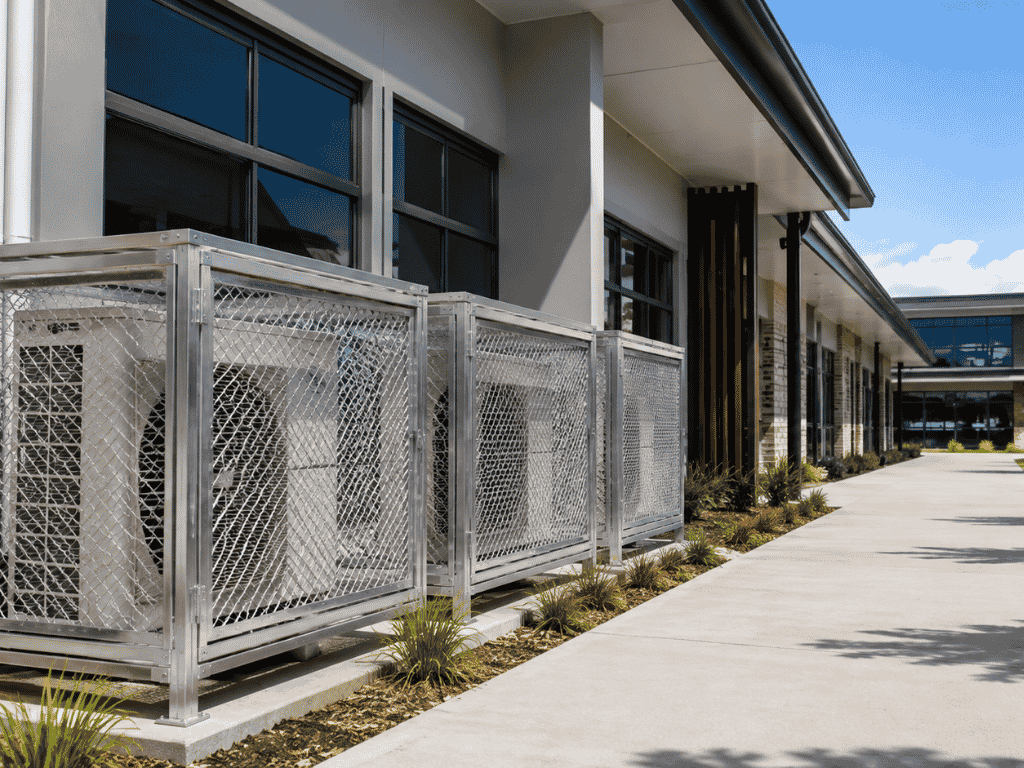
Security cages are a practical way to protect valuable equipment, essential infrastructure and stored items from unauthorised access, tampering and physical damage.
You will find them in many different environments, from school grounds and commercial buildings to apartment complexes, hospitality venues and public facilities. Although their basic purpose is straightforward, the type of equipment being protected and the conditions at each site can vary considerably.
That is why security cages are often designed around a particular application rather than treated as a one-size-fits-all product.
A cage protecting an outdoor air conditioning unit at a school, for example, has different requirements from an enclosure surrounding gas bottles behind a restaurant or a storage cage in an apartment basement.
In this guide, we look at some of the most common uses for security cages and why choosing the right design, material and configuration matters.
A security cage is a metal enclosure designed to restrict unauthorised access to equipment, infrastructure or stored items while still allowing appropriate visibility, ventilation and authorised access.
Depending on its purpose, a cage may be installed around mechanical or electrical equipment, gas cylinders, plumbing infrastructure, personal belongings, tools or other valuable assets.
Unlike a completely enclosed cabinet or room, many security cages use open metal mesh. This provides a physical barrier while maintaining visibility and airflow, which can be particularly important for equipment such as air conditioning condensers, solar inverters and gas bottles.
Security cages can also include lockable access points so authorised technicians, contractors or property managers can reach the equipment when required.
Equipment installed outdoors or in accessible areas can face a range of risks.
These may include accidental impacts, deliberate vandalism, interference with switches and controls, theft or unauthorised access. Equipment positioned in school grounds, shared commercial areas, public facilities and apartment buildings may be particularly exposed simply because more people can reach it.
A security cage adds another physical layer between the equipment and its surroundings.
Rather than preventing authorised use, the aim is to make important assets harder to interfere with while maintaining the access, airflow and visibility necessary for their intended operation.
Different sites will have different priorities, which is why choosing a cage designed for its particular application is important.
Schools are one of the environments where security cages can be especially useful.
Outdoor services and mechanical equipment are often positioned close to walkways, playgrounds, sports areas and other locations regularly accessed by students. Even when damage is not deliberate, exposed equipment can be vulnerable to balls, play equipment and general activity.
One of the most common school applications is protecting outdoor air conditioning condenser units.
Although condensers are made for outdoor operation, components such as panels, pipework, isolators and controls can still be affected by physical impact or interference.
An air conditioner cage creates a physical barrier around the unit while allowing the ventilation it requires to operate.
It can also make it harder for students or unauthorised people to access switches and other components, helping reduce avoidable interference and service callouts.
Where a school or government project has specific construction or project requirements, the cage should be manufactured according to the relevant specification rather than assuming a standard design will automatically be suitable.
Schools increasingly use solar installations, which can leave inverters and related equipment in accessible areas.
An inverter cage can help protect this infrastructure from physical impacts, vandalism and unauthorised access to switches or isolators.
Importantly, an enclosure around an inverter needs to consider airflow and service access as well as physical security. Technicians still need appropriate access to inspect and maintain the equipment.
Security cages are not limited to large commercial or government sites.
Residential properties, apartment complexes and strata developments may also benefit from secure enclosures, particularly where equipment or stored belongings are located in shared or easily accessible areas.
One practical residential application is secure storage.
Apartment buildings often have car parks, basements or shared areas where residents need somewhere to keep personal belongings. Lockable storage cages can create dedicated areas for storing items while making more efficient use of available space.
Depending on the site, storage cages may be configured as individual enclosures or multi-bay arrangements for several residents.
Custom sizing can be particularly useful in apartment buildings where columns, walls, parking spaces and other structural features affect the available area.
Solar inverter and battery installations can also be found on residential properties.
Where equipment is positioned in an accessible location, a purpose-built cage can reduce the opportunity for accidental damage or unauthorised interference while retaining the ventilation and maintenance access required for the system.
The cage needs to suit the actual system layout rather than simply enclosing the equipment as tightly as possible.
Commercial sites often contain valuable infrastructure that needs to remain accessible to authorised personnel while being protected from the public.
Depending on the type of business, this could include air conditioning units, gas bottles, solar equipment, utility infrastructure, tools or stored inventory.
Retail properties, offices, hospitality businesses, warehouses and other commercial buildings often rely heavily on air conditioning.
When an outdoor condenser is installed next to a walkway, car park, loading area or other accessible location, it may be exposed to accidental impacts or unauthorised interference.
A purpose-built AC cage can help protect the equipment without unnecessarily restricting servicing or ventilation.
This is particularly useful where a business depends on its air conditioning system for comfortable working, customer or operational conditions.
Restaurants, commercial kitchens, industrial facilities and other businesses may use gas cylinders that need to be appropriately stored and protected.
A gas bottle cage can provide a strong physical barrier around cylinders while maintaining the open construction needed for airflow and visual inspection.
Because gas storage requirements vary according to the installation and application, the enclosure should be designed around relevant site and installer requirements rather than relying on a generic cage.
Lockable access can also help prevent unauthorised handling of the cylinders.
Commercial properties, workshops, depots and warehouses may need secure areas for tools, equipment or inventory.
A lockable storage cage can provide a practical solution without requiring the construction of a fully enclosed storage room.
Depending on the available space, cages may be freestanding, wall-mounted or configured into multiple storage bays.
They can also be designed around unusual dimensions, making them useful when standard off-the-shelf storage solutions do not suit the site.
Publicly accessible facilities create a different set of security challenges because equipment can be exposed to large numbers of people every day.
Council facilities, community spaces, sporting facilities and other public sites may contain equipment that needs to be readily accessible for maintenance but protected from casual interference or vandalism.
Security cages can provide this separation.
Common applications can include gas storage, air conditioning equipment, utility infrastructure and other outdoor services.
A professionally fabricated enclosure can also present a neater appearance than an improvised barrier, which may be important where equipment is visible to visitors.
For council or infrastructure projects, project-specific requirements should always be checked before a cage is manufactured.
Utility equipment is another common application for security cages.
Gas and water meters can sometimes be located in exposed areas where accidental impact, vandalism or tampering is possible.
A purpose-built meter cage creates a controlled barrier around this infrastructure while retaining the visibility and access required by authorised personnel.
The cage dimensions and access arrangement should account for the exact meter installation and any servicing requirements.
Reduced pressure zone, or RPZ, valves are another type of infrastructure that can require physical protection.
These devices form part of plumbing and backflow prevention systems and may be installed in accessible outdoor areas.
An RPZ cage can help protect the valve assembly from interference and physical damage while allowing the necessary access for inspection and servicing.
Because plumbing installations and specifications vary, the enclosure should be selected or manufactured according to the requirements of the particular site.
A good security cage needs to do more than simply fit around the equipment.
Its design should consider what is being protected, where it is positioned and how authorised people will continue to access it.
Several factors are worth considering.
Security cages can be manufactured from materials including aluminium and steel.
Aluminium provides a lightweight, corrosion-resistant option and can be well suited to school, residential and exposed environments where easier handling is useful.
Steel offers greater strength and is galvanised for durability, making it suitable for applications where heavier-duty protection is required.
Neither option is automatically right for every project. Material selection should reflect the environment, security requirements and project specification.
Some equipment must have suitable airflow around it.
Air conditioners, inverters, batteries and gas bottle installations are examples where an inappropriate solid enclosure could create problems.
Open mesh construction can provide physical security while allowing airflow and visibility.
Required equipment clearances should also be considered before determining the final cage dimensions.
Equipment still needs to be maintained after a security cage is installed.
Lockable doors, removable sections or appropriately positioned openings can allow authorised technicians to reach equipment without dismantling the entire enclosure.
Thinking about maintenance during the design stage can save considerable inconvenience later.
A security cage should provide enough space for the equipment, operating clearances and servicing requirements.
Cages that are too small may interfere with access or equipment operation, while unnecessarily oversized cages may occupy valuable space.
Providing accurate equipment measurements, site photographs and project drawings can help ensure the finished enclosure suits the intended location.
How the cage is fixed to the site is another important consideration.
Depending on its design and application, a security cage may be bolted to concrete, wall-mounted or installed as a freestanding enclosure.
The appropriate method will depend on the cage, surrounding structure and site conditions.
Some applications can be accommodated by standard cage sizes, particularly where the equipment dimensions and surrounding space are straightforward.
However, many sites have obstacles or unusual layouts that make custom fabrication more practical.
A custom security cage may be worth considering when:
The goal is not simply to manufacture a larger or stronger enclosure. It is to create a cage that works with the equipment and its surroundings.
The best security cage will ultimately depend on where it is being installed.
At a school, limiting student access and protecting equipment from physical impacts may be the main concern.
For a restaurant, securely housing gas bottles while maintaining suitable ventilation and access may take priority.
For an apartment development, efficient use of basement or car park space may be more important when designing storage cages.
Commercial and council sites may need to balance equipment protection, durability, servicing access and project specifications.
Understanding the intended application before ordering makes it easier to choose the correct dimensions, material, mounting arrangement and access configuration.
Caged Up designs and manufactures security cages for a range of applications across schools, councils, commercial sites, trades and residential or strata environments.
Its product range includes air conditioner cages, RPZ cages, inverter and battery cages, gas and water meter cages, gas bottle storage cages and lockable storage cages.
Both aluminium and steel options are available, depending on the requirements of the project.
While standard options are available for some applications, much of Caged Up’s work is built to suit specific equipment dimensions, mounting requirements and site conditions. This can be particularly helpful where an off-the-shelf enclosure would not provide the correct fit or access.
Caged Up is based in Queensland and can also arrange delivery or shipping for projects elsewhere in Australia.
So, what are security cages used for?
In simple terms, they help create a secure physical barrier around equipment, infrastructure or stored items that would otherwise remain exposed.
Their applications can range from protecting air conditioning condensers and solar inverters at schools to securing gas bottles at restaurants, protecting utility equipment in public facilities and providing lockable storage within apartment developments.
The most effective security cage is one designed around its actual purpose. Material, ventilation, maintenance access, equipment clearances, mounting and site-specific requirements all need to be considered.
Rather than treating every enclosure as the same, choosing a cage suited to the equipment and environment provides a more practical long-term solution.
For schools, businesses, contractors, councils, strata properties and other sites requiring purpose-built equipment protection, Caged Up can manufacture security cages to suit a wide range of project requirements.
© 2026 Caged Up | All Rights Reserved | ABN: 64 686 235 763 | Developed by