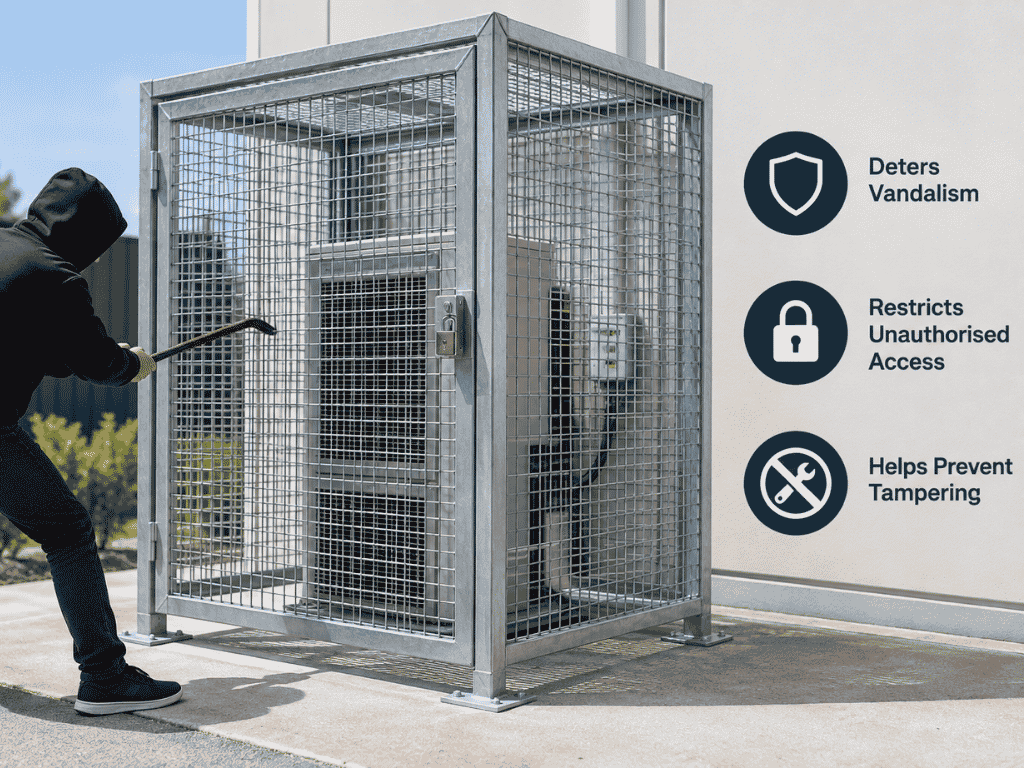
Outdoor equipment is often essential to the day-to-day operation of a property, but its location can also make it vulnerable.
Air conditioning units, gas meters, water meters, solar inverters, RPZ valves and other equipment are frequently installed in accessible outdoor areas. At schools, commercial premises, hospitality venues, council facilities and other busy sites, that can leave valuable infrastructure exposed to accidental contact, deliberate vandalism or unauthorised tampering.
A practical way to reduce that exposure is to install security cages around vulnerable equipment.
Rather than leaving important assets open and easily accessible, a purpose-built cage creates a strong physical barrier while allowing the equipment to remain accessible to authorised technicians when required.
For property owners, builders and facility managers, this relatively straightforward layer of protection can help reduce avoidable interference and give greater control over who can reach important infrastructure.
Many pieces of building infrastructure need to be positioned outdoors for practical or operational reasons.
An air conditioning condenser needs adequate airflow. Gas and water meters need to remain accessible for authorised servicing. Solar inverters and plumbing equipment may also need to be positioned where technicians can reach them.
The problem is that accessible equipment can also attract unwanted attention.
Depending on the location, exposed assets may be vulnerable to:
Schools and public facilities can be particularly exposed because equipment may be located close to walkways, play areas or other high-traffic spaces. Commercial properties may face similar risks around loading areas, car parks, service lanes, building exteriors and shared access zones.
Security cages introduce an additional barrier between the equipment and the people moving through these areas.
Vandalism does not always involve sophisticated attempts to damage equipment. In many cases, exposed assets are targeted simply because they are easy to reach.
A person walking past an unprotected air conditioning unit, meter or valve may be able to kick it, hit it or interfere with exposed components without encountering any meaningful obstruction.
Installing a security cage changes that.
A strong enclosure makes direct physical access more difficult. The equipment is still located in the same area, but there is now a protective structure between the asset and anyone who should not be touching it.
This can act as both a physical and visual deterrent.
It does not mean that vandalism becomes impossible, but it can reduce casual access and make interference more difficult than it would be with completely exposed equipment.
This is particularly useful for assets installed in high-traffic or unsupervised locations where moving the equipment itself is not practical.
Not every incident of tampering is deliberately destructive.
Someone may interfere with an isolator, touch a valve, access a control or move something without understanding its function. Even relatively minor interference can disrupt equipment operation or create the need for an unnecessary inspection or service call.
A lockable security cage helps establish a controlled-access area around the equipment.
Instead of anyone being able to walk up and reach the asset, access can be limited to authorised personnel such as contractors, maintenance teams or facility managers.
For schools, commercial buildings and government facilities, this can be especially valuable where essential services are located close to areas regularly used by students, staff, visitors or members of the public.
Good equipment security is not simply about protecting an asset from deliberate damage. It is also about reducing opportunities for accidental or unauthorised interaction.
Outdoor air conditioning units are a common example of equipment that can benefit from security cages.
Condenser units may be positioned at ground level beside classrooms, offices, shops or other buildings. Their exposed location can make external panels, pipework and related components vulnerable to impact or interference.
At schools, outdoor units may be located close to playgrounds, walkways and recreation areas. In commercial settings, they may sit beside service areas, loading zones or public access points.
An air conditioner cage creates a physical barrier around the unit while being designed with the equipment’s functional requirements in mind.
A suitable enclosure should protect the unit without unnecessarily restricting the airflow or maintenance access it requires.
Caged Up manufactures air conditioner cages in both aluminium and steel, with options designed for different site requirements and equipment sizes.
Gas and water meters are another form of infrastructure that can be exposed to tampering or accidental damage.
These assets may be installed in accessible areas around commercial premises, educational facilities, restaurants and council properties.
Because they contain important service infrastructure, preventing unnecessary interaction with them is particularly important.
A purpose-built meter cage helps restrict direct access while retaining controlled access for authorised personnel.
For gas meter applications, this can help protect controls and associated infrastructure from interference. Water meter cages can similarly provide a protective enclosure around exposed plumbing components.
The aim is not to make the equipment inaccessible. It is to make sure that the people who need access can obtain it while discouraging everyone else from interfering.
Reduced pressure zone, or RPZ, valves form part of backflow prevention systems and can also require protection when located in exposed areas.
Schools, commercial properties and other facilities may have these devices positioned where people regularly pass nearby.
Leaving the equipment completely open can create opportunities for accidental impact, tampering or deliberate interference.
An RPZ security cage provides a robust enclosure around the valve while allowing appropriate visibility and authorised access.
For projects with specific plumbing, council or project requirements, the cage itself may also need to be manufactured to particular specifications. This makes correct measurements and an understanding of the installation environment important when selecting an enclosure.
Solar infrastructure has become increasingly common across schools, businesses and other facilities.
While solar panels are normally installed out of easy reach, related equipment such as inverters may be positioned at lower levels where servicing is practical.
That accessibility can also make the equipment vulnerable.
A solar inverter cage can help prevent unnecessary contact while still taking airflow and servicing requirements into consideration.
As with air conditioning equipment, the enclosure needs to be designed around the asset rather than simply creating a closed box around it.
Measurements, ventilation requirements, mounting arrangements and access all need to be considered to ensure the security solution remains practical.
Security cages can also be useful beyond mechanical and electrical equipment.
Commercial kitchens, hospitality venues, council facilities and other properties may require gas bottles to be stored in designated outdoor areas. Depending on the location, leaving cylinders unprotected can expose them to unauthorised access or interference.
A suitable gas bottle cage provides a defined and secure enclosure while allowing the site to maintain appropriate access to the cylinders.
Storage cages serve a similar purpose for tools, equipment and other items that need to be kept in shared or accessible environments.
Lockable storage cages can be particularly useful in strata properties, commercial facilities and trade environments where separating stored goods from general access is important.
The effectiveness of a security cage depends on more than simply putting metal around an asset.
The enclosure needs to suit what it is protecting and where it will be installed.
A cage that is incorrectly sized may interfere with servicing or fail to provide suitable protection. An enclosure around air conditioning or electrical equipment also needs to account for ventilation, while meters and valves need to remain accessible to authorised technicians.
Important considerations can include:
This is one reason custom-built security cages can be valuable for projects where standard dimensions do not suit the equipment or installation area.
Caged Up manufactures cages to suit specific site layouts and specifications, while also offering standard-size options for suitable applications.
Material selection can also influence how well a cage suits its environment.
Caged Up manufactures security cages using aluminium and steel.
Aluminium is corrosion-resistant and relatively lightweight, making it a practical choice for many projects, including school and coastal environments.
Its lower weight can make handling and installation easier while still providing a strong enclosure around vulnerable equipment.
Steel is selected where greater strength and durability are priorities.
Caged Up’s steel cages are galvanised for durability, making them suitable for demanding applications where a robust protective enclosure is required.
Neither option is automatically right for every project. Equipment type, site conditions, security requirements and project specifications should all be considered when choosing between aluminium and steel.
One of the most important features of a well-designed security cage is controlled access.
Equipment still needs to be inspected, serviced and repaired.
A cage that makes maintenance unnecessarily difficult can create problems of its own. For this reason, security cages should provide suitable access for authorised contractors while keeping the general public or unauthorised users away from the equipment.
Lockable panels or doors can help achieve this balance.
The result is a protective enclosure that supports both security and practical maintenance requirements.
Security cages can suit a wide range of properties where equipment is installed in accessible areas.
Common applications include schools, commercial buildings, government facilities, council sites, hospitality venues, strata properties and infrastructure projects.
The need for a cage generally becomes more apparent when equipment is located in a place where people can easily reach it.
A facility manager assessing a site might consider questions such as:
Where the answer to these questions raises concerns, a security enclosure may provide a practical additional layer of protection.
Caged Up designs and manufactures security cages for schools, councils, commercial sites, contractors and other organisations that need to protect exposed equipment.
Its range includes air conditioner cages, RPZ cages, solar inverter cages, water meter cages, gas meter cages, gas bottle cages and storage cages.
Cages can be manufactured from aluminium or steel, with custom-built solutions available where equipment dimensions, mounting arrangements or site specifications require a more tailored approach.
Caged Up also offers standard-size cage options for suitable applications.
With cages fabricated in Queensland and supply available Australia wide, the focus is on creating practical enclosures that suit the equipment and environment they are intended to protect.
Whether the concern is vandalism, unauthorised tampering, accidental interference or simply controlling access to valuable infrastructure, choosing a correctly sized and appropriately designed cage can help reduce unnecessary exposure.
Outdoor equipment often needs to remain accessible, but that accessibility should not mean leaving valuable infrastructure completely unprotected.
Security cages provide a practical physical barrier around assets such as air conditioning units, meters, RPZ valves, solar inverters, gas bottles and stored equipment. By making direct access more difficult and allowing access to be controlled, they can help deter vandalism, reduce unauthorised tampering and protect equipment in busy or exposed locations.
The right solution depends on the asset, its location, required access, material preference and any relevant project specifications.
For schools, commercial properties, councils, contractors and facility managers looking to better protect exposed equipment, Caged Up can provide standard or custom-built security cage solutions designed around the requirements of the site.
© 2026 Caged Up | All Rights Reserved | ABN: 64 686 235 763 | Developed by