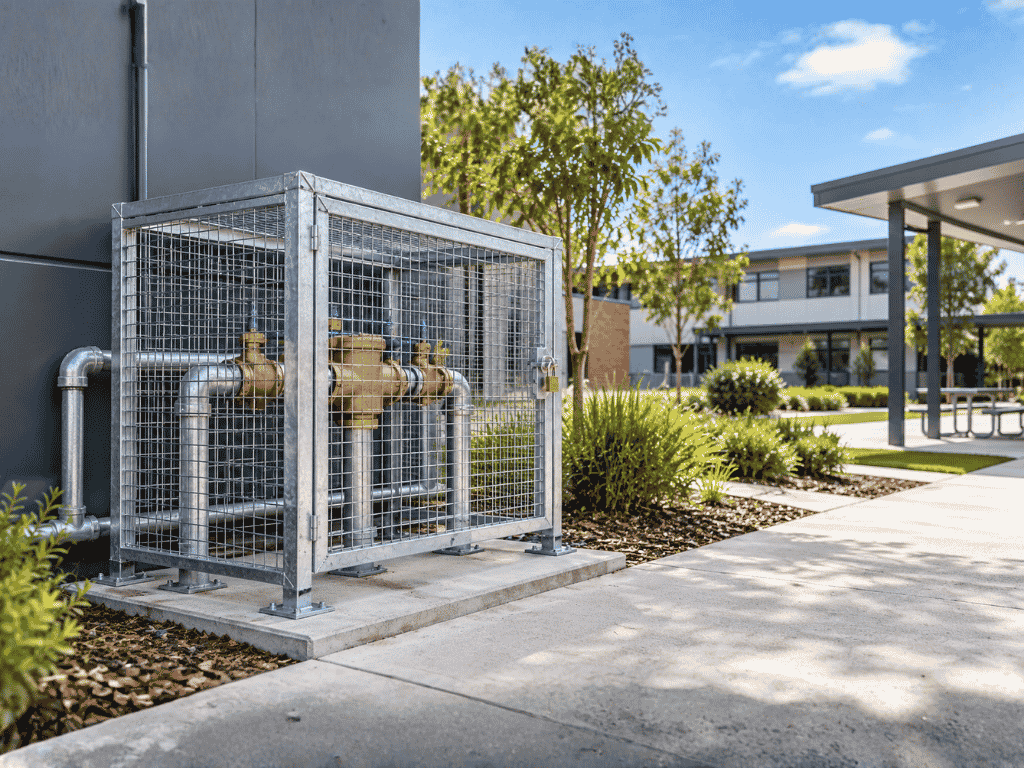
Backflow prevention devices may not be the most visible part of a school or commercial property, but they can play an important role in protecting the water supply.
Many of these devices are installed outdoors or in accessible areas where they may be exposed to accidental impact, vandalism, tampering or unauthorised interference. This is particularly relevant on school grounds, council facilities and busy commercial sites where outdoor infrastructure can be within easy reach of students, staff, contractors or members of the public.
A backflow cage provides a physical barrier around exposed backflow prevention equipment while still allowing authorised technicians to access the device when inspection, testing or maintenance is required.
For facility managers, builders, plumbers and property owners, choosing the right cage involves more than simply finding an enclosure that fits. The size of the device, installation location, mounting method, material, access requirements and project specifications all need to be considered.
This guide explains why backflow devices may require physical protection, what to look for in a backflow cage and how schools and commercial properties can choose a suitable solution.
Backflow occurs when water moves in the opposite direction to its intended flow, creating the potential for unwanted water or contaminants to enter a potable water supply.
Backflow prevention devices are installed within plumbing systems to help stop this reverse flow from occurring.
There are several types of backflow prevention devices, and the appropriate device depends on the plumbing system and level of risk involved. One commonly used testable device is a Reduced Pressure Zone device, usually referred to as an RPZ device or RPZ valve.
Because these devices form part of a property’s plumbing infrastructure, their installation, testing and maintenance must be handled in accordance with the applicable plumbing requirements. In Queensland, the QBCC notes that plumbers require a backflow prevention endorsement to test, commission or maintain backflow prevention devices.
A backflow cage does not perform the backflow prevention function itself. Its purpose is to provide physical protection around the plumbing equipment.
A backflow cage is a protective metal enclosure installed around exposed backflow prevention equipment, commonly a Reduced Pressure Zone (RPZ) valve.
You may also hear these products described as:
Their primary purpose is to restrict unauthorised access to exposed plumbing equipment and help protect it against physical interference.
Caged Up manufactures RPZ cages specifically for this purpose, with products designed for applications including schools, government facilities, councils and commercial sites.
A well-designed cage should protect the equipment without unnecessarily restricting the access required by plumbers and maintenance technicians.
Installing the correct backflow prevention device is only part of protecting a plumbing system. Where the device is installed can also affect how vulnerable it is to damage or interference.
Many RPZ assemblies are installed outdoors where the equipment remains accessible for inspection and servicing. Depending on the property, this may place the valve near walkways, landscaped areas, service zones, school grounds, car parks or other active areas.
Without additional physical protection, the device may be exposed to several risks.
Commercial properties and school grounds can be busy environments.
Maintenance equipment, trolleys, landscaping tools, sporting activities and everyday foot traffic may all create opportunities for exposed infrastructure to be accidentally struck.
A backflow cage creates a barrier between the equipment and surrounding activity, helping reduce the likelihood of direct physical contact.
Outdoor equipment can also become a target for vandalism.
Valves, fittings and pipework that are easy to reach may be interfered with, struck or damaged. A strong enclosure makes direct access more difficult and provides a visible deterrent against unwanted interference.
This can be particularly useful for infrastructure positioned in publicly accessible locations.
Not every incident of interference is deliberate vandalism.
People may touch, move or operate exposed equipment without understanding its purpose. On school sites, for example, equipment installed near areas accessible to students may attract curiosity.
A lockable backflow cage helps control access so that the equipment remains available to authorised contractors while being less accessible to other people.
Schools have several characteristics that can make protecting exposed plumbing infrastructure particularly important.
Large numbers of students move between classrooms, sporting areas, playgrounds and outdoor spaces throughout the day. Maintenance equipment, groundskeeping work and deliveries can also create regular activity around school buildings.
If an RPZ device is located within one of these accessible areas, a protective cage can help separate the equipment from everyday activity.
Caged Up specifically supplies RPZ cages for education and government environments and states that it can manufacture cages to suit relevant project specifications.
For school projects, the required enclosure may depend on factors such as:
Project managers should always check the actual documents and specifications that apply to their individual school project rather than assuming that one cage design will be suitable for every site.
Commercial properties can face similar risks, although the environment may be very different from a school.
An RPZ valve at an office complex may be located near landscaping or pedestrian areas. At a retail property, equipment may be positioned close to loading zones, service areas or customer-accessible spaces. Industrial and trade facilities may have vehicles and equipment moving around outdoor infrastructure.
A backflow cage can provide an additional layer of physical protection in these situations.
Potential applications include:
The right cage should reflect how the surrounding area is actually used rather than relying only on the dimensions of the plumbing device.
Not every RPZ installation is identical, so there are several factors worth checking before ordering a cage.
Start by measuring the entire backflow assembly rather than only one component.
The enclosure needs enough space to surround the equipment without interfering with valves, pipework or other services.
It is also important to consider the space technicians may require when testing or maintaining the device.
For unusual installations, custom fabrication may provide a better solution than trying to make a standard enclosure work in a restricted space.
Protecting an RPZ valve should not make legitimate servicing unnecessarily difficult.
Backflow prevention devices require appropriate inspection, testing and maintenance, so the cage design should allow authorised personnel to reach the necessary components. Queensland plumbing guidance also places specific requirements around the testing and reporting of testable backflow prevention devices.
Caged Up’s current RPZ cage design includes hinged access to help make servicing easier.
Before ordering, consider how the enclosure opens, where the lock is positioned and whether there is enough working space around the device.
The environment will influence the material used for a backflow cage.
Caged Up offers custom RPZ cage solutions in aluminium or steel depending on the project requirements. Its current standard RPZ product uses heavy-duty marine-grade aluminium with marine stainless fittings.
Factors that may affect material selection include:
There is no single material that is automatically right for every project. The choice should be based on the conditions and specification of the site.
A cage needs to deter unwanted access while remaining accessible to authorised personnel.
Lockable access can be especially useful in schools, public facilities and commercial properties where equipment is located in areas accessible to many people.
The locking arrangement should be practical for the facilities or maintenance team that will be responsible for the property.
How the cage attaches to the site is another important consideration.
Caged Up’s current RPZ range includes slab-mount options, with wall mounting also available.
The appropriate mounting arrangement will depend on the structure surrounding the backflow device and the project requirements.
Measurements should account not only for the valve itself but also for concrete slabs, walls, pipework and other obstacles that may affect installation.
Schools, councils, government facilities and commercial construction projects may have detailed specifications for equipment enclosures.
These can cover construction methods, materials, mesh, mounting, finishes and accessibility.
Caged Up states that it manufactures backflow cage solutions to suit project specifications, including cages designed for government and school environments.
If a specification is provided, it should be reviewed before manufacturing rather than after the cage arrives on site.
Standard-sized products can work well where the installation dimensions and mounting arrangement suit an existing cage.
However, backflow assemblies are not always installed in convenient locations.
Nearby walls, existing pipework, unusual valve arrangements, changes in ground level or limited clearance can make a standard enclosure unsuitable.
A custom backflow cage may be worth considering when:
Caged Up provides both product options and custom fabrication, with much of its work designed around specific site measurements and requirements.
No.
This is an important distinction for property managers and facility teams.
A backflow cage protects the physical equipment from external interference. It does not replace the required inspection, testing, servicing or maintenance of the backflow prevention device itself.
In Queensland, testing, commissioning and maintaining backflow prevention devices is specialised plumbing work requiring the appropriate backflow prevention endorsement.
The enclosure should therefore be selected with ongoing service access in mind.
Facility managers should maintain the required plumbing inspection and testing programme independently of the cage and ensure authorised contractors can access the device when necessary.
Caged Up designs and manufactures security cages for schools, councils, commercial properties, government projects and trades.
Its range includes dedicated RPZ cages designed to protect reduced pressure zone valves from physical damage, vandalism and unauthorised interference. Caged Up offers standard and custom RPZ cage solutions, with features including lockable access, hinged servicing sections and slab or wall-mounting arrangements. Custom projects can also be designed around site dimensions, material requirements and project specifications.
Caged Up manufactures its cages in Queensland and supplies security cage solutions for projects across Australia.
For projects with particular school, commercial or government specifications, providing dimensions, drawings and site requirements before ordering can help ensure the cage is designed around the actual installation.
Backflow prevention devices are important pieces of plumbing infrastructure, and where they are positioned in accessible outdoor areas, protecting them from physical interference should not be overlooked.
A well-designed backflow cage creates a physical barrier around an RPZ valve while maintaining the access authorised plumbers need for inspection, testing and maintenance.
For schools, this can help protect exposed equipment in areas with regular student and staff activity. For commercial properties, a cage can reduce the exposure of essential plumbing infrastructure to public access, accidental impacts and unauthorised tampering.
Choosing the right solution starts with understanding the site. Measurements, access requirements, mounting conditions, material selection and applicable project specifications should all be reviewed before ordering.
Caged Up manufactures RPZ and backflow cage solutions for schools, councils and commercial properties, with options available to suit different equipment dimensions and site requirements. By selecting an enclosure that suits the installation rather than simply choosing a generic cage, property owners and facility managers can provide practical long-term protection for important plumbing assets.
© 2026 Caged Up | All Rights Reserved | ABN: 64 686 235 763 | Developed by