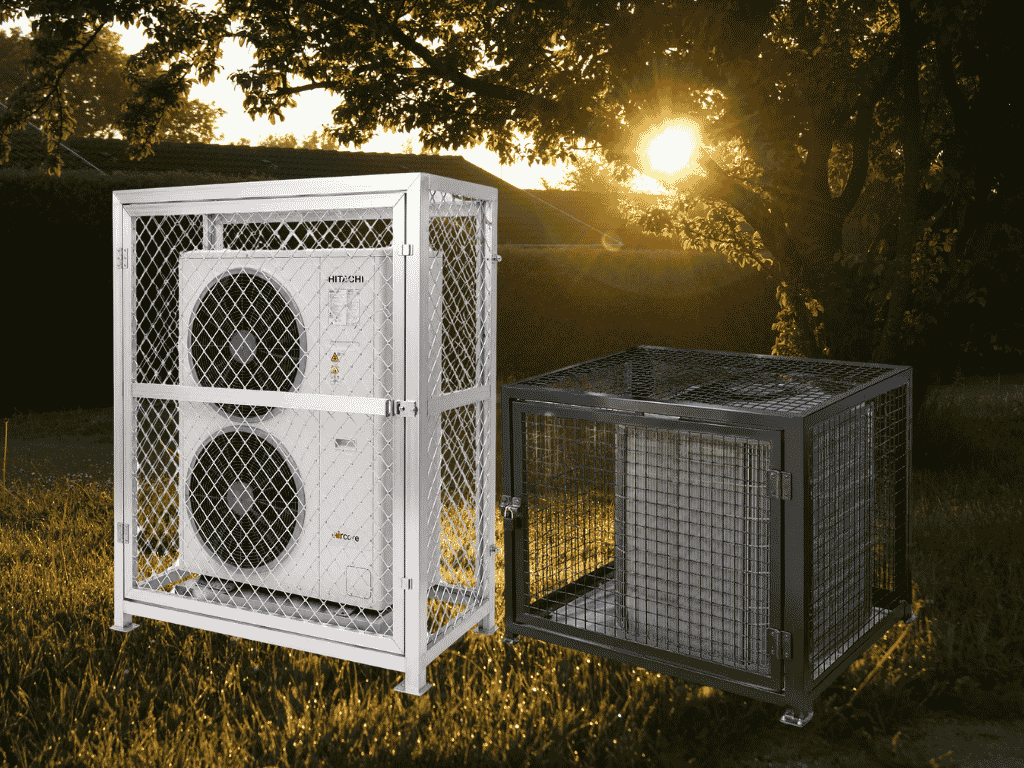
If you have been looking for a way to protect an outdoor air conditioning unit, you may have come across several different terms. Some suppliers talk about an aircon cage, while others refer to a condenser cage, AC cage or air conditioner security cage.
This can make a relatively simple purchase feel more complicated than it needs to be. Are these actually different products? Does a condenser cage only protect one part of the system? And which term should you use when requesting a quote?
In most everyday applications, an aircon cage and a condenser cage refer to essentially the same type of product: a protective enclosure installed around the outdoor unit of an air conditioning system.
The terminology may vary depending on who is searching, specifying or installing the equipment, but the overall purpose remains much the same.
Understanding the terminology can help you communicate your requirements more clearly and, more importantly, choose a cage that properly suits the equipment and the site.
An aircon cage is a protective enclosure positioned around the outdoor component of an air conditioning system.
Outdoor air conditioning equipment may be installed beside a building, on a concrete slab, against an exterior wall or in another accessible area. Depending on the location, the equipment can be exposed to accidental impact, interference, vandalism or unauthorised access.
An aircon cage creates a physical barrier around the equipment while allowing the unit to continue performing its normal function.
The design needs to account for more than security alone. An outdoor air conditioning unit requires adequate airflow and needs to remain accessible to qualified technicians for servicing, maintenance and repair work.
For this reason, a well-designed cage should suit the dimensions of the equipment, the manufacturer’s required clearances, the mounting arrangement and the conditions of the site.
Aircon cages are particularly relevant in environments where outdoor equipment is within easy reach, including:
The right design depends on the equipment and its surroundings rather than simply choosing an enclosure that looks large enough.
A condenser cage is another commonly used term for a protective cage fitted around the outdoor air conditioning unit.
The term comes from the way people commonly refer to the external part of a split-system or similar air conditioning system as the condenser unit.
This outdoor equipment contains important mechanical and electrical components and needs sufficient ventilation to operate correctly. Because it is usually positioned outside the building, it can also be more exposed to people, equipment and environmental conditions than the indoor components of the system.
A condenser cage places a strong physical enclosure around this outdoor equipment to reduce direct access without completely enclosing it.
It can be designed with mesh or open sections that provide protection while maintaining the ventilation required around the air conditioning equipment.
So, if a contractor asks for a condenser cage while a facility manager searches online for an aircon cage, they may be talking about the same basic product.
For most buyers, there is no significant practical difference between an aircon cage and a condenser cage.
The terms are commonly used to describe a security or protective enclosure around the outdoor air conditioning unit.
The main difference is usually terminology.
Someone responsible for building or facility management may naturally search for an “aircon cage” because they are looking for a cage to protect an air conditioner.
An HVAC contractor or someone familiar with air conditioning equipment may be more likely to use “condenser cage” because they are referring specifically to the outdoor unit.
You may also encounter terms such as:
Rather than focusing too heavily on the wording, it is more useful to focus on what needs to be protected and how the cage needs to perform.
Although the products described by these terms are generally the same, understanding the terminology can make the ordering process easier.
If you are searching online, knowing both terms gives you a better chance of finding the right product. It can also help when communicating with builders, electricians, HVAC contractors, facility managers and manufacturers.
More importantly, recognising that the terms overlap can prevent you from assuming you need two different products.
If you already have an outdoor AC unit that needs protection, the important questions are not whether you should buy an aircon cage or condenser cage. Instead, you should be asking whether the cage is correctly sized, suitably constructed and designed for the installation.
Outdoor air conditioning units are built to operate outside, but that does not mean they are protected against every type of physical interference.
Some sites create greater risks than others.
At a school, for example, an outdoor unit positioned near a playground, walkway or activity area may be vulnerable to accidental impact or interference.
At a commercial property, equipment installed near a loading area, car park, service lane or publicly accessible space may also require additional protection.
A properly designed cage can create a barrier between the equipment and its surroundings.
One of the main reasons for installing an aircon cage is to make the outdoor unit more difficult to access without permission.
A lockable enclosure can help discourage people from interfering with the equipment, controls or surrounding components.
This can be particularly useful at schools, commercial buildings and other locations where equipment is accessible to large numbers of people.
Not all damage is deliberate.
Outdoor units can be positioned close to areas used by students, workers, maintenance teams, landscaping contractors or delivery personnel.
A strong condenser cage can provide another level of physical separation between the unit and everyday site activity.
Commercial air conditioning equipment represents an important part of a building’s infrastructure.
Damage can potentially lead to repairs, disruption and periods when an area cannot be cooled or heated as intended.
While no cage can prevent every possible type of damage, protecting exposed equipment can form part of a practical asset protection strategy.
A condenser cage should never be treated as a completely sealed box.
Outdoor air conditioning equipment relies on the movement of air around the unit. Blocking or unnecessarily restricting that airflow can interfere with normal operation.
This is why purpose-built aircon cages generally use an open or mesh design rather than solid walls.
The amount of clearance required around a particular unit can vary, so the cage needs to suit the equipment manufacturer’s installation requirements.
Before selecting or ordering a cage, check the relevant clearances for the air conditioning unit and make sure they can still be maintained once the cage is installed.
The goal is to improve physical protection without interfering with the equipment’s intended operation.
Another important consideration is access for servicing.
Even a well-protected air conditioner will still require inspection and maintenance during its operating life.
If the cage makes routine servicing unnecessarily difficult, technicians may need to spend additional time gaining access to the unit.
A practical cage design should therefore consider how panels, covers and service points can be reached.
Depending on the design, this may involve lockable or removable panels that allow authorised personnel to access the equipment while helping keep it protected at other times.
Planning for service access from the beginning can make the installation more practical over the long term.
Once you understand that “aircon cage” and “condenser cage” generally describe the same product, the next decision may be the material.
Steel and aluminium are both used for protective AC cages, but the most suitable option will depend on the project.
Steel cages can provide a strong, robust protective enclosure and are well suited to installations where durability is an important consideration.
Caged Up’s steel AC cages are hot-dip galvanised after fabrication to improve corrosion resistance and suitability for outdoor conditions.
When comparing options, consider the cage construction, finish, mesh specification, mounting arrangement and the environmental conditions where it will be installed.
Aluminium provides another option for outdoor air conditioning protection.
Its lower weight and corrosion resistance can make aluminium a practical option for outdoor installations and projects where easier handling is important. Caged Up’s aluminium AC cages use marine-grade aluminium with marine stainless fittings for outdoor durability.
Again, the material should not be chosen in isolation. The cage needs to be suitable for the site, the required level of protection and the equipment being enclosed.
A specialist manufacturer can help determine which material and construction method best suits the project.
Another factor to consider is whether a standard-sized cage will work or whether the project requires a custom solution.
Standard cages can be convenient when the outdoor unit fits comfortably within the available dimensions and the installation location is relatively straightforward.
However, air conditioning units are available in many different sizes and site conditions vary considerably.
A custom cage may be appropriate when there are unusual equipment dimensions, limited installation space, multiple units or project-specific construction requirements.
Before ordering, it is useful to have accurate information about:
Providing these details helps ensure that the cage is designed around the actual installation rather than relying on guesswork.
If your goal is to protect the outdoor component of an air conditioning system, you generally do not need to choose between the two.
An aircon cage and a condenser cage are common terms for the same type of protective enclosure.
Instead, choose your cage based on the factors that will affect its performance.
Start with the size and model of the air conditioning unit. Check the manufacturer’s clearance requirements and consider where the equipment is located.
Think about who can access the area, the types of physical interference that may occur and how technicians will reach the equipment when servicing is required.
Then consider material, mounting method, locking arrangements and whether a standard or custom-built cage is more appropriate.
These details matter considerably more than the name used to describe the product.
Caged Up offers both aluminium and galvanised steel AC cages, with standard sizes as well as custom-built solutions for projects requiring specific dimensions, mounting arrangements or site specifications.
Cages can be designed with practical servicing and installation in mind, helping contractors and facility managers protect outdoor equipment while maintaining the access and ventilation the air conditioning system requires.
For projects with particular equipment dimensions or site requirements, providing unit measurements, drawings or installation details can help determine the most suitable cage arrangement.
The difference between an aircon cage and a condenser cage is mainly in the terminology.
Both terms are commonly used for a protective enclosure installed around the outdoor unit of an air conditioning system. You may also hear the same product described as an AC cage, air conditioner cage or condenser security cage.
Rather than deciding which name is technically better, focus on selecting a cage that suits the equipment and installation.
The right cage should provide appropriate physical protection while allowing sufficient airflow, technician access and the clearances required for normal operation.
Whether you are protecting equipment at a school, commercial property, government facility or another site, accurate measurements and careful consideration of the installation environment will help you choose an aircon cage that does the job properly.

© 2026 Caged Up | All Rights Reserved | ABN: 64 686 235 763 | Developed by