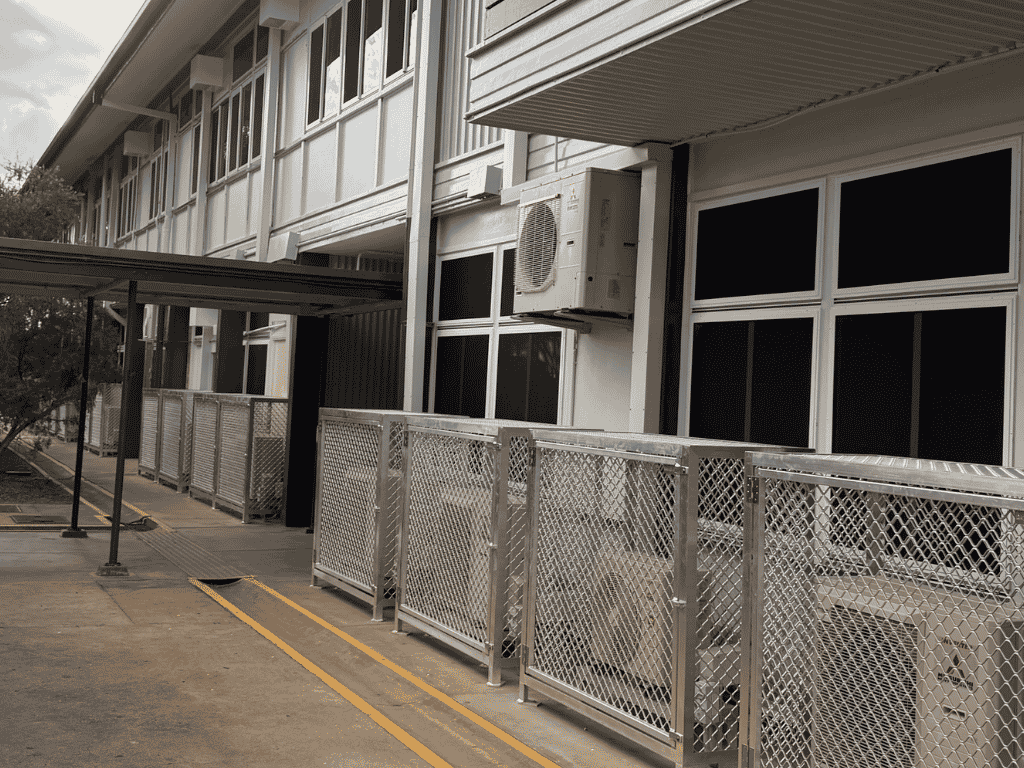
Outdoor air conditioning units are essential building assets, but their location can often leave them exposed to accidental damage, vandalism and unauthorised interference. For property managers and strata managers responsible for maintaining shared buildings, protecting these units can help reduce avoidable problems and make ongoing maintenance easier to manage.
An AC unit cage creates a physical barrier around an outdoor condenser while still allowing the airflow and service access required for normal operation.
However, choosing a suitable cage involves more than simply finding one that fits around the equipment. Property managers need to consider the environment, material, dimensions, access requirements, mounting location and the level of protection required.
This guide explains the main factors to consider when choosing an AC unit cage for commercial buildings, managed properties, strata complexes and other shared environments.
Outdoor air conditioning equipment is often installed in places that are easily accessible, including beside buildings, along walkways, within car parks, in courtyards and near common areas.
These locations may make maintenance convenient, but they can also expose equipment to accidental impacts, tampering or vandalism.
For a property manager, damage to an outdoor AC unit can create more than a repair bill. Depending on the property, a damaged condenser may lead to tenant complaints, uncomfortable indoor conditions, maintenance call-outs and disruption while repairs are organised.
A properly selected AC unit cage adds another level of physical protection around the equipment.
It can be particularly useful for:
The objective is not to completely isolate the air conditioning unit. A well-designed cage should protect the equipment while still considering ventilation, servicing and everyday operation.
Before choosing an AC unit cage, assess where the condenser is installed and what risks exist around it.
An air conditioning unit positioned in a secure plant area may have very different protection requirements from one located beside a public walkway or accessible car park.
Property managers should consider questions such as:
Understanding the site conditions first makes it easier to choose the appropriate cage design rather than selecting a product based on dimensions alone.
Correct sizing is one of the most important considerations when ordering an AC unit cage.
The cage needs to accommodate the outdoor unit while allowing suitable clearance around it. Selecting a cage that is too small may restrict access or interfere with the space required around the condenser.
Measurements should consider more than the width, depth and height of the AC unit itself.
Property managers or contractors should also look at surrounding features such as:
Providing accurate measurements, photographs or relevant equipment details to the cage manufacturer can help determine whether a standard size is suitable or whether a custom cage would be more practical.
For larger strata or commercial projects involving several different AC systems, checking each installation can also prevent problems caused by assuming every condenser is positioned in the same way.
Material selection can affect the weight, corrosion resistance, durability and suitability of an AC unit cage.
Caged Up manufactures AC cages in both aluminium and steel, allowing the material to be matched to the site and project requirements.
Steel is well suited to locations where heavier-duty protection is a priority.
Caged Up’s steel AC cages are designed for strength and durability and are hot-dip galvanised after fabrication to improve corrosion resistance for outdoor applications.
Steel may be worth considering for:
The weight of steel also means the mounting surface and installation method should be considered when planning the project.
Aluminium provides another practical option, particularly where corrosion resistance and lower weight are important considerations.
Caged Up’s aluminium cages use marine-grade aluminium with marine stainless fittings, providing a lightweight and corrosion-resistant option for outdoor applications.
They can be suitable for applications where property managers want a strong enclosure that is easier to handle during installation.
The right option depends on the environment and the level of protection required rather than simply choosing one material for every property.
An outdoor condenser needs adequate airflow to operate correctly, so the cage should not form a solid enclosure around the equipment.
This is one reason purpose-built AC cages use open mesh or grille construction.
When reviewing cage options, consider how the enclosure sits around the condenser and whether the design maintains appropriate space around the equipment.
The air conditioning manufacturer’s installation requirements should always remain an important consideration. Required clearances can vary between systems, so property managers should work with the relevant air conditioning contractor where necessary.
Protection is important, but it should not come at the expense of the AC system’s operating requirements.
Property managers regularly coordinate preventative maintenance, fault diagnosis and repairs. The AC cage should therefore make technician access practical.
A cage that is difficult to open or requires extensive dismantling every time the unit needs servicing can create unnecessary complications.
Look for features such as:
Caged Up’s current steel and aluminium AC cage designs include lockable front and rear panels and a removable top panel designed to assist servicing access.
This balance between security and accessibility is particularly important for strata and managed properties where multiple contractors may need to work on equipment over its service life.
A strong cage will only provide effective protection when it is appropriately installed.
The installation method will depend on where the AC condenser is positioned.
Some cages may be installed on a concrete slab or other suitable ground surface, while certain installations may require a wall-mounted configuration.
Caged Up offers AC cage configurations for ground or slab mounting as well as wall-mounting applications with additional panel options.
Before ordering, consider the structure surrounding the unit and identify how the cage can be securely positioned without interfering with pipework, electrical services or required AC clearances.
Property managers coordinating a larger project may want the HVAC contractor, builder or facilities team involved during the measurement stage so that the cage and proposed fixing method can be considered together.
Standard-sized cages can be convenient when an AC condenser and its surrounding installation fall within common dimensions.
However, many strata and commercial properties contain equipment that has been installed around existing structures and building services.
A custom AC unit cage may be more suitable when:
Caged Up offers both standard-sized and custom-built AC cage solutions, with custom products manufactured to suit site dimensions and project specifications.
For property managers overseeing multiple buildings, custom fabrication can also help address difficult sites without trying to adapt an unsuitable off-the-shelf enclosure.
If preventing unauthorised access is one of the main reasons for installing a cage, access points should be lockable.
This can help discourage people from opening the cage or interfering with the equipment while allowing authorised contractors to gain access when required.
Property managers should also consider how keys or padlocks will be managed.
For strata properties, it may be useful to establish who can access the cage, such as the building manager, facilities contractor or appointed air conditioning technician.
The security arrangement should be practical enough for legitimate servicing while discouraging unnecessary access.
Caged Up’s current steel and aluminium AC cages feature lockable front and rear panels, with padlocks available as an optional addition.
Security may be the main objective, but appearance can also matter in apartment complexes, office developments and commercial properties.
A large cage positioned beside an entrance, common area or customer-facing section of a building becomes part of the property’s exterior appearance.
A purpose-built enclosure generally provides a more professional result than an improvised barrier around the equipment.
Where aesthetics are particularly important, discuss available materials, finishes and customisation options with the manufacturer.
The goal should be to protect the equipment while keeping the installation appropriate for the surrounding property.
Property and strata managers often manage more than one condenser.
Instead of treating every cage as an individual purchase, it can be useful to assess the entire property first.
Create an equipment list that records:
This can make quotations and procurement easier, particularly where several cages are required.
It can also help create a more consistent approach to protecting equipment throughout an apartment complex, commercial property or portfolio of managed sites.
For multi-site property managers, developing a consistent specification for frequently encountered installations may simplify future replacements and upgrades.
Before placing an order, confirm how the cage will arrive and who will install it.
Some property managers may have existing builders, HVAC contractors or maintenance teams available to complete installation. Others may prefer installation assistance from the cage supplier.
Caged Up’s primary focus is manufacturing and supplying security cages, although installation can also be provided on request. The company is based in Queensland and offers shipping for AC cage solutions across Australia.
Considering logistics early is particularly useful for strata committees and portfolio managers coordinating work across several properties.
Before ordering, confirm the following:
Site: Where is the condenser located and what is it being protected from?
Dimensions: Have the unit and surrounding clearances been measured correctly?
Material: Is aluminium or galvanised steel more appropriate for the site?
Airflow: Will the cage maintain appropriate clearance around the condenser?
Access: Can technicians easily reach the unit for maintenance?
Mounting: How will the cage be fixed to the site?
Security: Does the cage provide lockable access where required?
Design: Is a standard cage suitable or is custom fabrication required?
Installation: Who will install the cage?
Quantity: Are there other units at the property that should be assessed at the same time?
Working through these points before purchasing can help property managers select a solution that works for both immediate equipment protection and ongoing building maintenance.
Caged Up designs and manufactures AC unit cages for schools, commercial properties, contractors, government projects and other sites requiring protection for outdoor air conditioning equipment.
Options include aluminium and galvanised steel cages, with both standard sizes and custom-built solutions available for different condenser dimensions, mounting arrangements and site requirements.
Caged Up can work with project dimensions and installation requirements to help determine a practical cage configuration. Cages can be supplied for installation by your existing builder, air conditioning contractor or maintenance team, with installation also available on request.
For property and strata managers responsible for multiple units or properties, discussing the complete project requirements early can help ensure each cage is suited to its intended location.
Choosing an AC unit cage involves more than placing a metal enclosure around an outdoor condenser.
Property managers and strata managers need to consider the equipment dimensions, airflow, servicing requirements, material, mounting arrangement, location and level of security required. Getting these details right can provide practical protection without making routine maintenance unnecessarily difficult.
Steel may be appropriate where heavier-duty protection is required, while aluminium provides a durable and corrosion-resistant option with a lighter construction. Standard cages can suit straightforward installations, while custom-built cages provide greater flexibility where space, pipework or site layouts create additional challenges.
By assessing the site carefully and selecting a purpose-built solution, property managers can provide better protection for exposed AC equipment while keeping servicing and long-term property maintenance in mind.
Caged Up manufactures standard and custom AC unit cages for projects across Queensland and Australia. If you are managing a commercial property, strata complex or multiple sites, speak with Caged Up about the dimensions, site conditions and protection requirements of your project.
© 2026 Caged Up | All Rights Reserved | ABN: 64 686 235 763 | Developed by