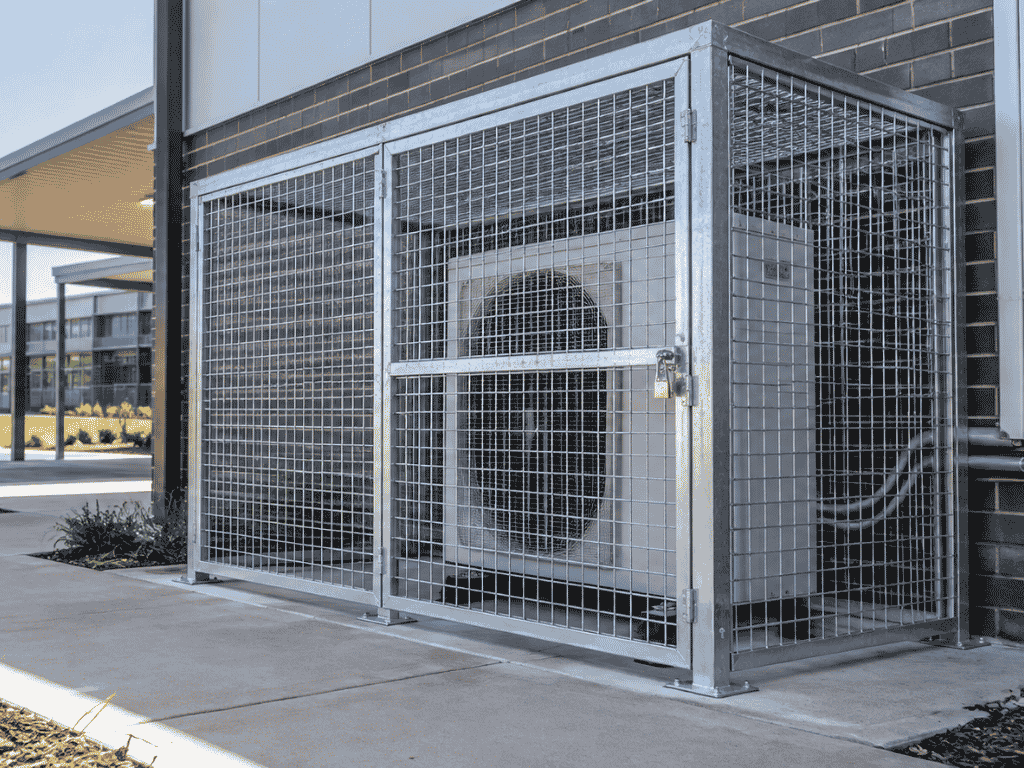
Schools, council facilities and commercial properties rely on a wide range of equipment to keep their buildings and operations running smoothly. Air conditioning condensers, solar inverters, backflow prevention equipment, gas bottles and utility infrastructure are often installed outdoors or in areas that can be accessed by staff, students, contractors or the public.
While this equipment is designed to perform an important function, its location can leave it exposed to accidental impacts, vandalism, tampering and unauthorised access.
For organisations responsible for maintaining valuable infrastructure, installing purpose-built security cages can provide a practical layer of physical protection.
Choosing the right security cages in Australia is not simply a matter of surrounding equipment with metal. Institutional and commercial sites need solutions that suit the equipment, installation environment, access requirements and relevant project specifications.
This guide looks at where security cages can be useful across schools, councils and commercial sites, as well as the factors facility managers, contractors and project teams should consider before ordering.
Outdoor equipment can be vulnerable simply because of where it needs to be installed.
An air conditioning condenser beside a school walkway may be within easy reach of students. A solar inverter installed on an exterior wall may be accessible from a public area. Gas cylinders behind a hospitality venue can require additional protection against unauthorised access, while exposed plumbing equipment may be vulnerable to interference or impact.
For organisations responsible for multiple buildings or facilities, damage to this equipment can create more than a repair bill.
It may also lead to operational interruptions, unnecessary contractor callouts, maintenance delays and additional work for facility teams.
A security cage creates a physical barrier around vulnerable equipment while still allowing the appropriate level of visibility, ventilation and authorised access for maintenance.
The exact design required will depend on what is being protected and where it is installed.
Schools are one of the environments where equipment protection can be particularly important.
Outdoor infrastructure is often located close to playgrounds, walkways, sports areas, service zones and other spaces used throughout the day. Even when damage is not deliberate, exposed equipment may be affected by balls, bicycles, landscaping equipment or general student activity.
Unauthorised interference can also become an issue where switches, isolators, pipework or mechanical components are within easy reach.
Air conditioning equipment is essential in classrooms, administration areas and shared school facilities, but outdoor condenser units are often installed at ground level.
An air conditioner cage can help reduce access to the unit and provide protection against accidental impact, vandalism and tampering.
Importantly, an AC cage needs to be designed around the operational needs of the condenser. Airflow should not be unnecessarily restricted, and technicians still need suitable access for servicing, cleaning and repairs.
Caged Up manufactures aluminium and steel air conditioner cages, with standard sizes as well as custom-built options for different site and equipment requirements.
As schools continue to use solar energy systems, associated equipment such as inverters and batteries may also require protection.
Solar inverter cages can limit unauthorised access to switches and components while maintaining the airflow and service access required for the installation.
Where a project includes both HVAC and solar equipment, using purpose-built cages across the site can also provide a more consistent approach to infrastructure protection.
Reduced Pressure Zone, or RPZ, valves are another type of infrastructure commonly found on school and government sites.
Because these devices may be located outdoors, they can be vulnerable to accidental impacts and interference.
A purpose-built RPZ cage provides a protective enclosure around the valve while allowing authorised access for inspection and servicing. Caged Up offers RPZ cage solutions designed around project requirements, including site dimensions, access needs and relevant specifications.
Council and government-managed assets can present a different set of security challenges.
Public parks, community centres, sporting facilities, maintenance depots and other municipal properties may contain valuable infrastructure in areas that cannot always be continuously supervised.
Equipment installed in publicly accessible locations can therefore benefit from additional physical protection.
Depending on the facility, this may include cages for:
A major consideration for council and government projects is ensuring that the cage suits the specific installation rather than relying on a generic enclosure that may interfere with servicing or other equipment requirements.
Measurements, mounting methods, required openings, access points and material selection should all be considered before fabrication.
This is where custom security cages can be particularly useful.
Rather than attempting to make the equipment fit a predetermined enclosure, the cage can be designed around the infrastructure and installation environment.
Commercial properties can contain a considerable amount of valuable equipment outside the secure interior of the building.
Retail centres, restaurants, offices, warehouses, workshops and hospitality venues may all have mechanical, electrical or utility infrastructure positioned in service lanes, loading areas, car parks and exterior walls.
These locations are convenient for operation and servicing but may also expose equipment to accidental impacts or unauthorised access.
Air conditioning condensers located near customer areas, loading zones or service lanes can be vulnerable to damage.
Installing a suitable cage creates a protective perimeter while maintaining the ventilation necessary for condenser operation.
Facility managers should consider service access when selecting the cage design. Technicians may need to clean coils, inspect connections or replace components, so protecting the unit should not make normal maintenance unnecessarily difficult.
Restaurants, hospitality businesses, maintenance facilities and other commercial sites may use gas cylinders that require secure storage.
A gas bottle cage can help restrict unauthorised access while providing an open enclosure suitable for visibility and ventilation.
Caged Up manufactures custom gas bottle storage cages for commercial, hospitality and council applications, with options developed around site layouts and project requirements.
Commercial sites may also need to secure meters, equipment or general utility storage.
Purpose-built storage cages can help businesses separate valuable or sensitive equipment from public or general-access spaces while still allowing authorised personnel to reach it when required.
Material selection is an important part of specifying security cages in Australia.
Caged Up uses both aluminium and steel, with the appropriate choice depending on the environment and project requirements.
Aluminium is a popular option where corrosion resistance and lower weight are important considerations.
Its lighter construction can make handling and installation easier, while its resistance to corrosion makes it suitable for many outdoor environments.
Caged Up commonly uses aluminium for school and commercial projects, including air conditioner, inverter and RPZ cage applications.
Steel may be preferred where greater strength and heavy-duty durability are priorities.
Caged Up’s steel cage options are galvanised for durability, making them suitable for applications where greater strength and robust outdoor protection are required.
Because steel cages require additional fabrication and finishing processes such as galvanising, lead times may differ from aluminium options.
The right material should ultimately be selected according to the application, environmental exposure, site specification and required level of protection rather than price alone.
Not every project needs the same solution.
Some common applications can be accommodated using standard cage sizes, which may simplify ordering and installation. Caged Up offers standard-size options for selected products and can ship cage solutions to customers around Australia.
However, much of the company’s work is also built to suit specific project requirements.
Custom fabrication may be appropriate where:
Providing accurate measurements, drawings, photographs and project specifications before ordering can help ensure the finished cage suits the installation.
Security is only one part of a practical cage design.
Most of the equipment being protected will eventually require inspection, maintenance or replacement. Facility managers should therefore consider how authorised contractors will reach the equipment after the cage has been installed.
Depending on the application, this could mean incorporating hinged sections, lockable doors, removable panels or other access arrangements.
For example, an air conditioning technician may need sufficient space to clean a condenser coil and inspect connections, while an RPZ valve needs to remain accessible for appropriate servicing.
Planning this access during the design stage can avoid having to modify or remove the enclosure later.
Schools, councils, builders and facility managers are often responsible for more than one item of equipment or even multiple properties.
Taking a consistent approach to equipment protection can make procurement and future maintenance easier.
Instead of treating every exposed asset as an isolated problem, project teams can identify which infrastructure is vulnerable across the site and determine where cages would be appropriate.
For example, a school upgrade may involve protecting several air conditioning units as well as a solar inverter. A council facility may require cages around HVAC equipment, RPZ valves and utility infrastructure.
For larger projects and multi-site requirements, working with a supplier capable of producing cages to specified dimensions can help create greater consistency across installations.
Before requesting a quote or placing an order, it is worth gathering the information required to specify the cage correctly.
Start with accurate equipment dimensions, including the height, width and depth. Consider the amount of clearance required around the equipment and identify any pipes, cables, switches or surrounding structures that may affect the enclosure.
The installation surface is also important. A cage installed on a concrete slab may have different fixing requirements from one attached to a wall.
Project teams should also consider:
Getting these details right before fabrication can help avoid delays and ensure the cage performs its intended role once installed.
Caged Up designs and manufactures security cage solutions for schools, councils, commercial properties, government projects, builders, facility managers and trade professionals.
Its product range includes air conditioner cages, RPZ cages, solar inverter cages, gas and water meter cages, gas bottle cages and storage cages, along with related products such as condenser stools.
Cages are available in aluminium and steel, with both standard-size and custom-built solutions available depending on the product and project requirements.
While manufacturing and supply are the core focus, installation can also be quoted on request. Caged Up is based in Queensland and provides shipping options for customers across Australia.
For organisations managing valuable outdoor equipment, this provides the flexibility to specify a cage around the actual installation rather than settling for a solution that does not properly suit the site.
Schools, councils and commercial facilities rely on outdoor infrastructure that can be difficult to keep completely out of reach.
Air conditioning condensers, solar inverters, RPZ valves, gas cylinders and other essential assets can all be exposed to accidental damage, vandalism or unauthorised interference when installed in accessible areas.
Purpose-built security cages provide a practical way to reduce that exposure while still considering ventilation, visibility and maintenance access.
The right solution will depend on the type of equipment being protected, its location, material requirements, fixing method and any project-specific specifications.
For organisations looking for security cages in Australia, Caged Up offers a range of standard and custom-built solutions for education, council, government and commercial applications. By planning the enclosure around the equipment and the conditions of the site, facility managers and contractors can achieve practical protection without compromising the ongoing operation or servicing of important infrastructure.
© 2026 Caged Up | All Rights Reserved | ABN: 64 686 235 763 | Developed by