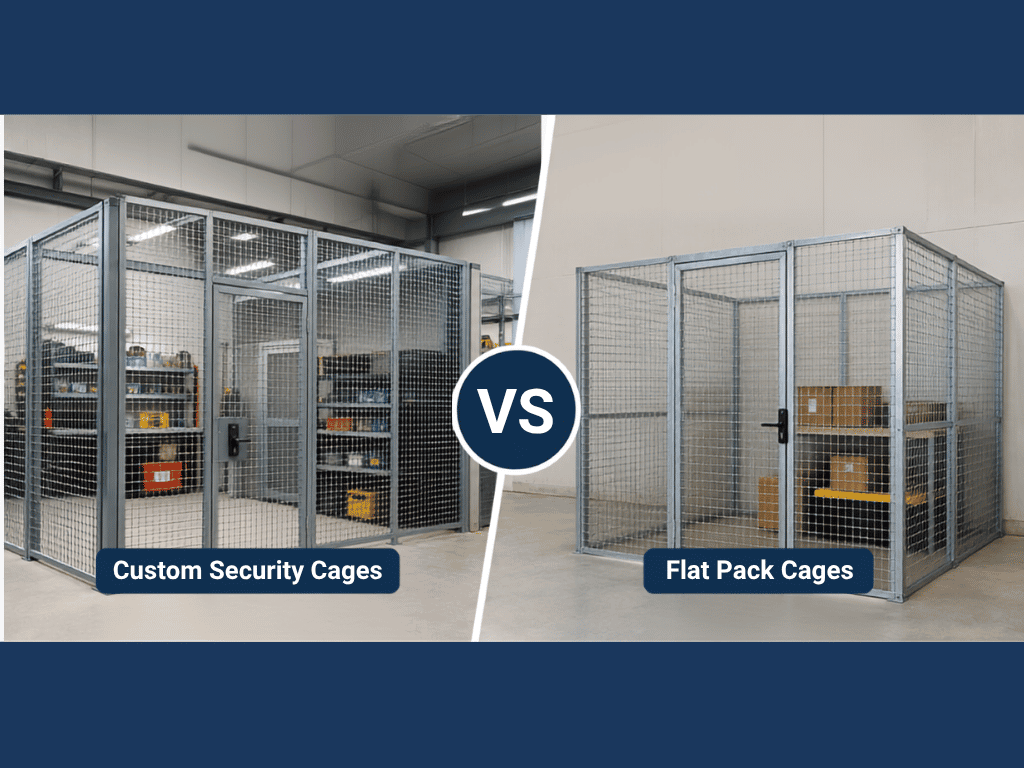
Security cages are used across schools, commercial properties, hospitality venues, infrastructure sites and other workplaces to help protect valuable equipment from theft, vandalism, tampering and accidental damage.
However, choosing a cage involves more than simply finding one that is large enough to cover the equipment.
Depending on the product and application, one consideration may be whether an available standard cage will suit the job or whether the project calls for a custom-built solution.
Both options can provide practical protection when selected for the right application. The main difference is how closely the cage needs to match the equipment, site layout, mounting requirements and project specifications.
Understanding these differences can make it easier to choose security cages that provide the right combination of protection, installation convenience and long-term suitability.
A flat pack security cage is manufactured in a standard size and supplied in sections for assembly.
For suitable projects, this approach can make ordering and transport straightforward. Rather than having a cage individually designed around a particular site, you select a standard size that accommodates the equipment and available installation area.
Caged Up offers flat-pack configurations for selected products and standard-size applications, providing an option where efficient freight and on-site assembly are important considerations.
Flat pack options can be especially useful when the dimensions and layout are relatively straightforward and there are no unusual obstacles that require a specially designed enclosure.
The key is checking measurements carefully before ordering. A standard cage still needs enough room around the equipment for its intended operation, servicing and installation requirements.
A custom security cage is fabricated to suit the particular dimensions and requirements of a project.
Instead of adjusting the site to accommodate a standard enclosure, the cage can be designed around the equipment, available space, material requirements and mounting method.
This can be particularly valuable when dealing with unusual layouts or equipment installed around pipework, services, walls, concrete slabs or other physical restrictions.
Caged Up states that most of its work is built-to-order because individual sites can have different requirements.
Custom security cages may be designed for applications including:
A purpose-built cage allows important site-specific considerations to be addressed before manufacturing begins.
Neither option is automatically better for every project.
The right choice depends on what is being protected, where it is installed and whether a standard cage can meet the requirements of the site.
Here are some of the most important factors to compare.
A standard flat pack cage is most suitable when the available installation area comfortably accommodates one of the available sizes.
For example, if equipment is positioned on an open concrete area with suitable clearance around it, a standard cage may provide a straightforward solution.
Things become more complicated when space is restricted.
Outdoor equipment is often positioned next to walls, pipework, electrical services, fences or other infrastructure. In these situations, an enclosure may need dimensions that are different from a standard product.
A custom cage can be manufactured around those limitations.
Before deciding, measure both the equipment and the available installation area rather than relying only on the dimensions of the unit itself.
The equipment inside the cage can also influence the design.
A security cage protecting an air conditioner has different practical requirements from an enclosure protecting gas bottles, an RPZ valve or a solar inverter.
Access, airflow, mounting location and surrounding services may all need to be considered.
Standard cages work well where the equipment and installation conditions match the available configuration. When the application has more specific requirements, custom fabrication gives greater flexibility.
This is one reason it is useful to select security cages based on the actual application rather than approaching them as a one-size-fits-all product.
Flat pack cages are designed to make transport and on-site assembly practical.
For contractors working across multiple locations, having a standard product that can be transported efficiently and assembled where required may simplify the process.
Custom cages can also be straightforward to install when they have been correctly designed for the site. In fact, getting the dimensions and mounting requirements right during fabrication can reduce the need for unexpected modifications during installation.
Caged Up advises that many customers use their existing contractors or facilities teams for installation, while installation can also be arranged when requested.
Whichever option is selected, accurate measurements and proper planning remain important.
Not every security cage is being installed purely as a general deterrent.
Schools, councils, government facilities and commercial projects may have specific requirements covering how an enclosure is fabricated or installed.
These requirements can include factors such as:
Where a project has a particular specification, the cage should be selected or manufactured against those requirements rather than assuming that a standard design will automatically be suitable.
Caged Up regularly manufactures cages for schools, councils and contractors and can fabricate custom solutions around relevant project specifications.
For specification-driven work, custom fabrication often provides greater flexibility because the enclosure can be designed around the documented requirements of the project.
Caged Up manufactures security cages using aluminium and steel.
Aluminium is corrosion-resistant and can be particularly useful in environments where corrosion resistance is an important consideration.
Steel provides a strong option and can be galvanised for durability.
Material choice should therefore be based on the environment, application and project requirements rather than simply choosing whichever option is cheapest.
If a project has a specified material or finish, this should be confirmed before the cage is ordered.
Protecting equipment should not make routine access unnecessarily difficult.
Air conditioning systems, valves, meters, solar equipment and other infrastructure may require inspection, maintenance or repair during their working life.
The enclosure therefore needs to balance security with practical access.
For a straightforward installation, a standard cage may already provide suitable access.
More complicated layouts may benefit from a custom design that takes service access into account. For example, the position of openings or the cage dimensions may be adjusted around the way technicians need to reach the equipment.
Thinking about servicing during the design stage can help prevent inconvenience later.
Where a flat-pack configuration is available, the separated sections can make transport easier than moving a fully assembled enclosure.
This can be useful for interstate projects, contractor supply or locations where moving a large welded cage into position would be difficult.
Caged Up ships products Australia wide and works with customers to arrange suitable delivery solutions.
Custom cages may also be delivered depending on the project and design, but dimensions and transport requirements should be considered when planning larger enclosures.
For projects involving multiple sites, it is worth discussing quantities and delivery requirements before ordering.
A standard flat pack security cage may be the right option when:
The main advantage is simplicity.
When the site suits the standard design, there may be little benefit in commissioning a completely bespoke enclosure.
However, the dimensions should always be checked carefully before ordering.
Custom security cages become particularly useful when the project cannot be adequately addressed with a standard size or configuration.
A custom solution may be more appropriate when:
The goal is not customisation simply for its own sake. It is about creating an enclosure that works properly for the equipment and environment it is intended to protect.
It is tempting to compare flat pack and custom security cages based solely on the initial purchase price.
That does not always provide the full picture.
A standard product can be economical when it fits the site correctly. However, selecting the wrong size and then modifying the cage or surrounding area during installation can create additional work and expense.
Likewise, a custom cage may involve more project-specific fabrication, but it can also reduce installation complications by being designed around the site from the beginning.
A better approach is to consider overall suitability.
Ask whether the cage:
The best-value solution is generally the one that performs its intended job without unnecessary modifications or compromises.
Start with accurate information.
Measure the equipment, inspect the surrounding area and identify anything that may affect the cage installation. For commercial or government work, check the project drawings and specifications before ordering.
Useful information may include equipment dimensions, site photographs, required materials, mounting details and any access or construction requirements.
If a suitable standard-size or flat-pack configuration is available for the application, it can provide a practical and convenient solution.
If the location presents unusual dimensions, restricted access or project-specific requirements, a custom-built cage may be the better choice.
Caged Up manufactures security cages in Queensland and supplies solutions for contractors, schools, councils, facility managers, commercial businesses and other organisations. Standard and custom options allow the cage to be selected according to the actual requirements of the job rather than forcing every project into the same solution.
Choosing between custom and flat pack security cages ultimately comes down to the site.
Flat pack cages can be an efficient solution when the equipment fits a standard size, the installation area is straightforward and the standard design meets the project’s requirements.
Custom security cages offer greater flexibility when dimensions, services, mounting arrangements, access requirements or project specifications make a standard enclosure unsuitable.
Before ordering, consider what is being protected, the available space, how the cage will be installed and how the equipment will need to be accessed in the future.
Caged Up offers selected standard-size and flat-pack options alongside custom-built security cage solutions, depending on the product and project requirements. If you are unsure which option suits your project, providing accurate measurements, site information and project requirements can help identify the most practical solution.
© 2026 Caged Up | All Rights Reserved | ABN: 64 686 235 763 | Developed by